

May 9, 2026
-
Steven Ashman
Operations Manager
Imagine living in London without electricity, telephones, cars, the internet, a health service, meaningful sanitation – this was the world into which the LCF was born in 1852. But this was also a time of change from a technological point of view and also in terms of social reform. The century had already seen the likes of William Wilberforce, Robert Peel (who incidentally studied law) and the Earl of Shaftesbury (Lord Ashley) exerting their influence to bring about reforms such as the Abolition of Slavery (1807), the introduction of the Metropolitan Police (1829) and the passing of the Factory Act (1844). Christian men, used by God, to bring about changes.
The latter half of the 19th century saw the Lawyers’ Prayer Union (LPU) grow, members joined from all over the UK (York to Yeovil, Somerset to Scarborough, Cambridge to Carlisle) and while the records show little of what was accomplished specifically in the name of the LPU, there are many accounts of the works that the members were able to accomplish, often while working together in the way described in Proverbs 27:17.
John MacGregor has been quoted as saying; “No matter what the gift be… it came from God, and was ready for His using“1, and the early members of the LPU seemed to put this into practice with all of their energies. MacGregor himself went on to work with many other causes (the Open-air Mission he established in 1853 held 700 meetings in its first year2), but those whom MacGregor inspired to join were similarly driven to serve the Lord often while working in very demanding roles.
Lord Cairns was a member, the youngest Lord Chancellor of the 19th Century, but one drawn to support works such as Barnardo’s while also being ready to declare in public; “on the seventh day I am God’s man only“3 – resulting in him declining to take cases which would involve him working on the Lord’s Day.
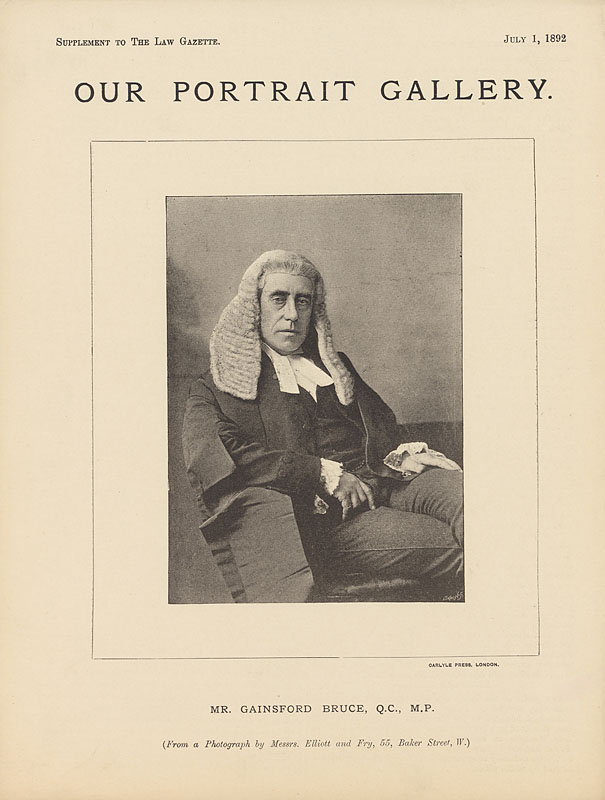
Philip Vernon Smith was a committee member and like many of the men in the LPU, an author. These were men who were well taught doctrinally and therefore able to write books which would be helpful to many others (in addition to those who also wrote legal books such as Hon. Mr. Justice Gainsford Bruce and Hon. Baron Charle Edward Pollock chairmen in 1901 and 1892 respectively – who co-authored a book on the Laws of Merchant Shipping4). Smith, in addition to his legal work, also found time to be involved with the Church Missionary Society and even at the age of 75, was ordained as a deacon by the Bishop of Gloucester.5
Other members are recorded as having to deal with the more regular things of life – Henry O’Brien O’Donoghue working on highway planning6, Thomas Houghton Hodgson handling a case of assault7. Harry Nisbet (one of the first secretaries of the LPU) even found himself summoned for not muzzling his dog in public8!
But, some members had harsher experiences of the realities of the sinful world, Robert Anderson (one of the early committee members) became the Assistant Police Commissioner in charge of the Whitechapel murders, resulting in a nervous breakdown.9
All of these people served the world around them while being members of the LPU, the challenge that they have laid down, is to try to live up to the standards they set. Using Alexander Haldane as an example, he knew MacGregor before the LPU was founded, he was involved with men like Dr. Livingstone and Lord Shaftesbury, but he was also driven to work with the Open-air Mission and the British and Foreign Bible Society. His obituary is telling; “Very many will feel his loss, but it is all gain to him who loved and served the Master so devotedly.10 ”
Written by Steve Ashman, Wales
1 Wenham S. (2015) John MacGregor (“Rob Roy”): Explorer, Philanthropist and Sportsman (1825-1892) p.17
2 Greenbank A.J. (2003) This is the Lord’s doing p.12 (https://www.oamission.com/open-air-mission/wp-content/uploads/2023/03/This-is-the-Lords-doing-OAM-150th.pdf)
3 Marsh W. (1885) Brief memories of Hugh McCalmont, first Earl Cairns, Nisbet & Co, p.12
4 A Compendium of the Law of Merchant Shipping; with an Appendix containing all the Statutes of practical utility,” (1881)
5 The Times (London, England), Friday, Jan 11, 1929; pg. 14; Issue 45098.
6 https://somerset-cat.swheritage.org.uk/records/Q/SR/704/35-40
7 https://www.tandfonline.com/doi/full/10.1080/0078172X.2021.1872971#d1e122
8 Bexley Heath and Bexley Observer, 28 December 1889
9 Representative Men at Home: Dr. Anderson at New Scotland Yard from Cassell’s Saturday Journal June 11, 1892 (pages 895-897) quoted in https://www.casebook.org/dissertations/rn-anderson1892.html?printer=true)
10 Corsbie AH (1882) “A Biographical sketch of Alexander Haldane” 18 p.38