

August 9, 2026
-
The Rt. Hon Lord Denning
-
Dr Martin Lloyd-Jones
Presidential address
Rt. Hon. Lord Justice Denning
One hundred years ago this month a Barrister named John McGregor on the 9th February 1852, founded this Fellowship under the name then of the Lawyers’ Prayer Union. Every month the members held meetings in the Vestry of St. George’s Church, Bloomsbury. Every year they held meetings in a bigger hall which they took for the purpose.
Our Fellowship has gone on for this last 100 years in the self same way with the self same spirit. At these meetings members of the profession, Judges, Barristers, Solicitors and Clerks stood up and paid their own testimony to the influence of religion and prayer in their lives.
Amongst those who were members of this Fellowship you will find some of the great names in the Law, though I do not say they are worth more than those who are not so well known. You will find Lord Cairns, Lord Caldecote, Lord Hailsham, Lord Justice Lush, Mr. Baron Pollock, Mr. Baron Pigott, Mr. Justice Archibald, and many others attending these meetings over this one hundred years, just as we do this evening, and offering their testimony.
It is interesting to note that as long back as 1904 Mr. Inskip, as he then was, was the Secretary of the Society. Afterwards he, as Sir Thomas Inskip, was the defender in the House of Commons of the Book of Common Prayer. Later he was Lord Chancellor and Lord Chief Justice. I well remember that he came and spoke to us one evening. So also did General Dobbie, who, it is said, defended Malta with a sword in one hand and a Bible in the other.
This meeting is notable in that our membership has doubled within the last five years, doubled from what it has ever been before. One of the early members recorded that the members of this Union are a small company compared with the great number of people engaged in the law, but nevertheless a great influence for good, much greater than the actual numbers.
It is right that Lawyers should be men of religion. The object of the Law is to do justice and to see that truth is observed. How does anyone know what is truth or what is justice? It comes of the right spirit in man. How is that right spirit created? Only by true religion from which the right spirit will naturally flow. Religion shows the spirit of man how to find truth and justice, whereas Law is just the daily application of it, however imperfectly, in our everyday affairs.
I will not detain you longer now because we have here Dr. Martyn Lloyd-Jones who is going to talk to us. He is not a lawyer himself, but is the brother of a Queen’s Counsel whom you will all know.I will not add any testimony of my own: may I just give you one instance of the influence of prayer. I have a friend, a Professor of Law, whose son won the V.C. for one hundred bombing raids over Germany, involving great destruction of many homes and innocent lives. Since the war that man has devoted himself to the relief of chronic incurables and provided them with a home.
There was a large unused house belonging to a relation of the family and in that house he took a chronic invalid from cancer. He nursed the man himself. Gradually, more patients and nursing staff arrived. How did the money come to run that home? He is a deeply religious man who spent many hours in prayer, and the money has come: on one occasion 800 pound notes came in a brown paper parcel, with no indication as to where it came from. After our first visit there, my wife happened to be writing to a friend and mentioned incidentally that we had been to this home. She did not ask her friend for money, or even hint at it, but this friend sent £30 together with £5 from a friend, and we felt quite sure all this was the result of prayer.
That is only one instance. Many others you will know yourselves. I only add this testimony because that has been done in this Society over the past 100 years. Many members of the profession have given testimony of the influence of prayer and religion in their daily lives and work.
How much I regret that Mr. Robbins is absent this afternoon: he has been a great mainstay of the Society all these years. I would also like to thank Mr. Coningsby for all the great work he has done as Secretary. His monthly letters have been of the greatest interest to everybody.
The place of law in the divine economy
Dr. Martyn Lloyd-Jones
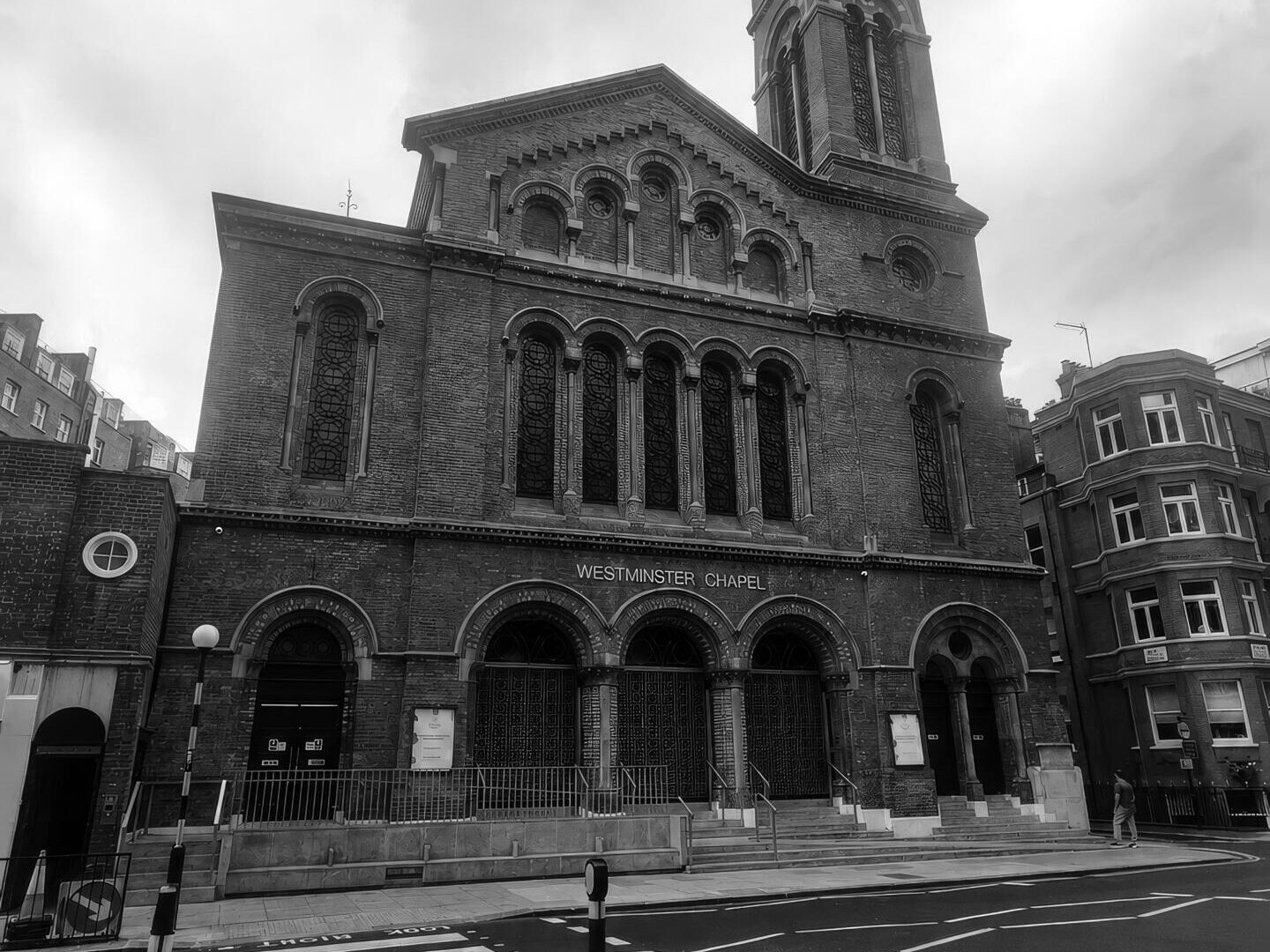
Mr. Chairman, ladies and gentlemen, may I be allowed to say at once that I am deeply conscious of the honour you do me by asking me to deliver an address on this important and historic occasion. There are certain advantages in being the Minister of Westminster Chapel. One is that when people are desirous to hold their meetings in this Hall, they think that the request for its use may perhaps have a more favourable reception if they ask the Minister of the Church to address the meeting! Thus it comes to pass that I am given this high honour and privilege this evening.
I was interested, sir, to notice that you made reference to a fact which I also had intended to emphasise, namely, that many people seem to be surprised at discovering that there is such a body as the Lawyers’ Christian Fellowship. It seems to come as a matter of great surprise to the average person that members of your profession can possibly be Christians! A friend, speaking to me about this meeting the other day, said that he was looking forward to it with great eagerness. I told him that for myself I felt somewhat nervous and apprehensive. This astonished him; he said, “I should have thought that you would have been very happy indeed amongst lawyers, and speaking about the law.” I still cannot quite make up my mind as to whether this was intended as a compliment!
To me it is not a matter for surprise that there should be such a body as the Lawyers’ Christian Fellowship, for I have always felt that on the contrary it is something that one should expect. I always feel that lawyers and members of the medical profession of all people should be Christians, were it merely for the reason that they are constantly dealing with personalities, with men and women who are face to face with life and its many problems. Members of those professions, therefore, should be men and women who think seriously about life and its attendant problems.
Unfortunately we must admit that there are members of both professions who do not always conform to Christian standards. Indeed, sometimes they have the reputation of being far removed from such ideals. Why is it that the average doctor and lawyer is not normally a person who is well known for his Christian profession? I have found it interesting to meditate upon this problem.
Why aren’t lawyers known for their Christian faith?
I have a feeling that there are probably three main explanations. The first is that “familiarity breeds contempt.” Members of these professions are so familiar with the sad and sometimes sordid incidents in life that they cease to react to them in the normal manner. This very familiarity tends to harden them and to lessen their reaction.
The second explanation is what the Apostle Paul puts in the famous words: “Evil communications corrupt good manners.” One cannot be constantly in the realm of things which are doubtful or corrupt without unconsciously becoming influenced and affected.
But the third explanation (which is not only the most charitable, but also in my opinion the most likely to be true) is that members of these professions are apt to develop a protective mechanism to shield themselves from these constant assaults upon their feelings and susceptibilities.
However, in return more directly to this meeting and its object. I assert again that no one who has a true conception of the nature of law should be surprised at the existence of the Lawyers’ Christian Fellowship.
But, alas, how easily we tend either to misunderstand or to forget the true nature of law. The moment we remind ourselves of the purpose and the function and the true spirit of law, we are more or less compelled to think in Christian terms. The tragedy is that so many, like the Pharisees of old, are apt to miss the wood because of the trees. They, you remember, were so immersed in the details of the law that they were prone to forget its real purpose and function, and to neglect its cardinal principles: that was the main charge which was brought against them by Our Lord and Saviour.
The divine economy
I would like, then, to address you on the place of law in the divine economy, or, if you prefer it, I want to deal with the theology of law. This is a very great subject, and I wish, sir, that I had the leisure and the time which you customarily allot to those who have the privilege of addressing you in other places, to deal with such a great theme.
As it is however, I shall have to be content with laying before you certain general principles which you will have to elaborate and fill out for yourselves.
What then is the function of law in God’s plan? To answer this question, we must go to the Bible: for we have no authoritative statement save that which is to be found in the Bible itself. There we find that the fundamental point is that all law originates from God. God in His sovereignty has indeed decreed all the orders of society. None of the orders of society, such as the family or the State, are of human origin or invention; they were not thought out by man at the beginning; they have all been ordained by God.
You remember how the Apostle Paul in the 13th chapter of the Epistle to the Romans tells us clearly that “the powers-that-be are ordained of God.” Elsewhere in the Bible we are told that God determined the bounds of man’s habitation, and divided up the nations: He also decreed the various orders of society. The impression given in Genesis is that all this became necessary as the result of the Fall of Man and the entry of sin into the world.
The first and central proposition therefore is that all law everywhere originates from God. Certain societies may be very primitive, and their conception of law may be most unworthy and corrupt, but whatever the character of the laws as such, or the conception of such people of the law, it all came originally from God.
Now that is a general statement which we find in the Bible with regard to the whole of mankind. Nevertheless, it is quite clear that in the Bible we have a special revelation with respect to law as well as that more general revelation. God created the Children of Israel as a nation for Himself in order that through them He might teach the entire world of mankind certain vital truths concerning Himself and their relationship to Him. God gave to the Children of Israel what is called the Mosaic Law, which is found recorded in certain Books of the Old Testament. If, therefore, we are anxious to discover the true function of law in the divine economy, the best procedure is to make a careful and detailed study of the law given through Moses. I am anxious to stress again the fact that the truth concerning the Mosaic Law is equally applicable to all law, though it may not be quite so clear and patent on the surface.
The revelatory function of law
What then do we find, from a study of the Mosaic Law, is the true function and purpose of law?
The first answer to that question is that clearly the law is meant to serve a revelatory function. Its first business is to reveal certain things. What are the things that it reveals? Primarily we must say that the law is meant to reveal certain things about God Himself. It reveals that God is the great law-giver and the moral governor of the universe. It teaches us that the world has not an independent existence, but that God is over all and above all, and that all things are in His hands.
Revealing God’s character
The law reveals that God is the supreme law-giver, and that all ideas of right and wrong and morality derive from Him and His revealed will. The law also reveals the fact that God is the judge of all the world, and as such that He makes certain demands upon us. Here I think it is important that we should realise that all idea of judging derives from God as “the judge of all the earth.” You may recall that in the Epistle to the Ephesians (chapter 3, verse 15) Paul argues that all fatherhood is ultimately derived from God. In exactly the same way, we must remember that all ideas of judges and judgment derive from God.
Again we find that the law reveals the holiness and the righteousness and the eternal justice of God. There is never anything arbitrary in God, and all His judgments are in accordance with His eternal attributes. Man’s mind in sin, alas, always has loose and unworthy notions of the character of God. The law is a permanent reminder to us of His absolute holiness, absolute righteousness and absolute justice.
Indeed, we must never allow ourselves to think even of the love of God apart from this. This obviously is most vital in connection with our ideas concerning the doctrine of the Atonement. Many stumble at this point because they think nature of law. The moment we remind ourselves of the purpose and the function and the true spirit of law, we are more or less compelled to think in Christian terms. The tragedy is that so many, like the Pharisees of old, are apt to miss the wood because of the trees. They, you remember, were so immersed in the details of the law that they were prone to forget its real purpose and function, and to neglect its cardinal principles: that was the main charge which was brought against them by Our Lord and Saviour.
The divine economy
I would like, then, to address you on the place of law in the divine economy, or, if you prefer it, I want to deal with the theology of law. This is a very great subject, and I wish, sir, that I had the leisure and the time which you customarily allot to those who have the privilege of addressing you in other places, to deal with such a great theme.
As it is however, I shall have to be content with laying before you certain general principles which you will have to elaborate and fill out for yourselves.
What then is the function of law in God’s plan? To answer this question, we must go to the Bible: for we have no authoritative statement save that which is to be found in the Bible itself. There we find that the fundamental point is that all law originates from God. God in His sovereignty has indeed decreed all the orders of society. None of the orders of society, such as the family or the State, are of human origin or invention; they were not thought out by man at the beginning; they have all been ordained by God.
You remember how the Apostle Paul in the 13th chapter of the Epistle to the Romans tells us clearly that “the powers-that-be are ordained of God.” Elsewhere in the Bible we are told that God determined the bounds of man’s habitation, and divided up the nations: He also decreed the various orders of society. The impression given in Genesis is that all this became necessary as the result of the Fall of Man and the entry of sin into the world.
The first and central proposition therefore is that all law everywhere originates from God. Certain societies may be very primitive, and their conception of law may be most unworthy and corrupt, but whatever the character of the laws as such, or the conception of such people of the law, it all came originally from God.
Now that is a general statement which we find in the Bible with regard to the whole of mankind. Nevertheless, it is quite clear that in the Bible we have a special revelation with respect to law as well as that more general revelation. God created the Children of Israel as a nation for Himself in order that through them He might teach the entire world of mankind certain vital truths concerning Himself and their relationship to Him. God gave to the Children of Israel what is called the Mosaic Law, which is found recorded in certain Books of the Old Testament. If, therefore, we are anxious to discover the true function of law in the divine economy, the best procedure is to make a careful and detailed study of the law given through Moses. I am anxious to stress again the fact that the truth concerning the Mosaic Law is equally applicable to all law, though it may not be quite so clear and patent on the surface.
The revelatory function of law
What then do we find, from a study of the Mosaic Law, is the true function and purpose of law?
The first answer to that question is that clearly the law is meant to serve a revelatory function. Its first business is to reveal certain things. What are the things that it reveals? Primarily we must say that the law is meant to reveal certain things about God Himself. It reveals that God is the great law-giver and the moral governor of the universe. It teaches us that the world has not an independent existence, but that God is over all and above all, and that all things are in His hands.
Revealing God’s character
The law reveals that God is the supreme law-giver, and that all ideas of right and wrong and morality derive from Him and His revealed will. The law also reveals the fact that God is the judge of all the world, and as such that He makes certain demands upon us. Here I think it is important that we should realise that all idea of judging derives from God as “the judge of all the earth.” You may recall that in the Epistle to the Ephesians (chapter 3, verse 15) Paul argues that all fatherhood is ultimately derived from God. In exactly the same way, we must remember that all ideas of judges and judgment derive from God.
Again we find that the law reveals the holiness and the righteousness and the eternal justice of God. There is never anything arbitrary in God, and all His judgments are in accordance with His eternal attributes. Man’s mind in sin, alas, always has loose and unworthy notions of the character of God. The law is a permanent reminder to us of His absolute holiness, absolute righteousness and absolute justice.
Indeed, we must never allow ourselves to think even of the love of God apart from this. This obviously is most vital in connection with our ideas concerning the doctrine of the Atonement. Many stumble at this point because they think only of one of the attributes of God, namely. His love; but the Apostle Paul reminds us in the third chapter of the Epistle to the Romans that the central glory of the Cross is that at one and the same time it manifests the fact that “God is both just and the justifier of the ungodly.”
Any ideas of forgiveness which do not do full justice to God’s law and therefore to His essential righteousness and justice, must be rejected. As Paul concludes in that mighty argument in that third chapter in the Epistle to the Romans: “Do we then make void the law through faith? God forbid: yea, we establish the law.”
Revealing human nature
The second revelatory function of the law is in regard to man. Why is the law needed? Why are rules and regulations essential? The Biblical answer is because man is sinful, and therefore needs to be restrained from doing that which is wrong. It teaches that as a result of the Fall, all mankind has become sinful, and that a bias towards evil has entered into our very nature and constitution. The Biblical history at the very beginning of Genesis makes this abundantly plain and clear. The moment sin entered, all sorts of complications arose, and man immediately needed to be restrained and kept within bounds. The very fact of law, therefore, reveals perhaps more clearly than anything else the fact that man not only sins in his actions, but that he has also become sinful in his nature.
The second thing that it reveals concerning man is that he is an accountable and responsible being. Though man has fallen and has become sinful, he is still a moral being. He has not become an animal: he still remains a man, and as such he is responsible for his life and actions in this world. In a sense, therefore, the giving of the law to man pays man a very real compliment; even in sin he is still a moral and accountable being. It thus reveals the essential greatness of man as one who was made originally in the image of God.
The third thing which the law reveals concerning man is that he is subject and liable to judgment. It reminds us that we shall all have to stand before the Judge eternal. The scriptures tells us that it is appointed unto men once to die and after death the judgment, it proclaims that each one of us will have to give an account to God of his life in this world. This. I know, has been most unpopular teaching during the past hundred years, and men have done their utmost to explain it away as a kind of vestigial remain in the realm of thought; but surely the very existence of law, and the necessity for law drives us to the conclusion that man is both accountable and subject to judgment.
Revealing the extent of sin
The third aspect of law as a revelation is that which deals with the concept of sin. It is the law which reveals to us, and brings home to us, the true character of sin. As the Apostle Paul puts it, its function is to show us “the exceeding sinfulness of sin.” (Romans vii. I3).
Our ideas of sin tend always to be superficial and inadequate. The law defines sin; it focuses attention upon it; it shows us its true character. That is why it always enters into detail and never allows us to be content with mere generalisations. Strictly, however, the law reveals to us the true nature of sin in the way in which the Apostle argues in the 7th chapter of the Epistle to the Romans. His case is that though the law is just and good and holy, because our natures are sinful even the law tends to stimulate and to arouse the desire for sin within us. Nothing so shows the terrible character of sin.
The restraining function of law
The second main function of law is to restrain. When man had fallen into sin. God introduced the system of law and government in order to keep sin within bounds. The full consequences and effects of sin must be restrained, otherwise the whole of life would become chaotic.
Were it not for the introduction of law, the world would have destroyed itself. Law does not remove sin or destroy it; but it puts a definite bound and limit upon its manifestations. It is concerned about the preservation of order. It is designed to make life in society possible. It is concerned always with the realm of personal relationships. Because of sin each man has become self-centred and selfish and is concerned about himself alone: because each one is like this, if we were left to ourselves, life would be nothing but constant strife, and the end would be inevitable chaos. Therefore God introduced law to place a restraint upon this tendency and to keep it within bounds.
The non-reformatory function of law
We come now to our third consideration of the function of law. This I have put in a negative form. Law should never be conceived of as having a reformatory character. This is a most vital point. It is never the business of law to reform. I am anxious to emphasise this because there are many loose ideas current at the present time with respect to this matter. Certain people who think sentimentally regard the chief function of law as being reformatory: but that, according to the Biblical teaching, is entirely false. The concept of law must never be viewed in too positive a character.
Certain serious consequences follow at once the moment we begin to think it is possible to reform a man’s character by means of law. It contradicts the plain statement of the Epistle to the Romans (chapter 8, verse 3) where we read, “For what the law could not do, in that it was weak through the flesh,” and also the similar statement in chapter 3, verse 20, where we are told explicitly. “By the law is the knowledge of sin.”
But indeed we can go further, and state that were it possible for law to reform or to save man, the coming of Our Lord into this world, and His life, and especially His death and resurrection would have been quite unnecessary. Thus we see that to think of the law as something which is designed to reform or to improve man and the world strikes at the very heart of the central Biblical message of God’s way of salvation through Jesus Christ His Son.
The ultimate purpose of law is grace
I am happy to think, however, that I do not have to end on this negative note. If the function and the purpose of the law is not to reform man, what is its purpose? Here we can answer with confidence in the famous words of the Apostle Paul to the Galatians, that the law is “our schoolmaster to bring us unto Christ.” Its ultimate purpose, therefore, is one of grace. There is perhaps no verse which is quite so frequently misunderstood and misinterpreted as the 17th verse of the first chapter of the Gospel according to St. John, where we read, “For the law was given by Moses, but grace and truth came by Jesus Christ.” This verse must never be interpreted in such a way as to set up law and grace as antitheses: the grace of God is to be seen even in the law. What the Apostle is asserting is that the full manifestation of the grace of God and the full truth about God’s gracious purpose with respect to man was manifested only in the coming of His only begotten Son, our Lord and Saviour Jesus Christ.
How then do we find this element of grace in the law? For one thing, it announces that God has not turned His back upon the world, that God has not cast off the world and ceased to be interested in it. It is as though God said, “I am going to keep in touch with the world through the law until the time comes when I shall send My only begotten Son into the world Who will fulfil the law.” It was a part of God’s purpose to bring us eventually to that knowledge that is only to be obtained in the Lord Jesus Christ. It is thus that the law acts as our schoolmaster.
The nature of sin
It does this in several different ways. It shows us the real nature of sin. It is only when man truly understands that the law says “Thou shalt not covet,” that he is immediately convicted and sees his utter failure.
In the same way, the law brings sin home to us and shows us our desperate need of forgiveness. So long as we think of sin only in terms of sins and particular actions, we never truly see our need of forgiveness. It is only when, under the influence of the teaching of the law, we see sin as transgression against God and disobedience of God, that we realise we have offended Him, and therefore need His forgiveness. It is only then we begin to understand what David meant when he cried out in anguish, “Against Thee, Thee only, have I sinned.” Here again, by stressing our need of forgiveness the law acts as a schoolmaster to bring us to Christ.
The evil nature in us
It is however, still more searching than that, for it ultimately shows us the evil nature that is within us. Why is it that the law is needed at all? Why is it true to say that “the natural mind is enmity against God; it is not subject to the law of God, neither indeed can it be”? Why is it right to say, as we read in St. John’s Gospel, chapter 3, verse 19: “And this is the condemnation, that light is come into the world, and men loved darkness rather than light, because their deeds were evil”?
The answer is, that as a result of the Fall our natures have become evil; we love and prefer the darkness, and we hate the light. It is a true understanding of the law that enables us to perceive this. It is only as we discover God’s real purpose with respect to mankind, and the kind of life that He would have us to live that we discover our natural rebelliousness; and that in turn brings us to see that our greatest need is the need of a new nature, of a new life.
Our weakness
In the same way, the law helps us to see our utter weakness and helplessness, our need of strength and power. The greatest Saints of the Old Testament were incapable of keeping the law. The Apostle Paul is able to assert without fear of contradiction in writing to the Romans: “There is none righteous, no, not one”; “All have sinned and come short of the glory of God”; “The whole world lieth guilty before God.” The law tells us what we ought to be, and what we ought to do, but it does not supply us with the power to conform to those standards.
As the Apostle again reminds us, “By the law is the knowledge of sin.” It cannot supply us with the dynamic that we need: it fails to save because of the weakness of our flesh and our complete inability to carry out its high demands. Thus the law demonstrates to us our great need of power and of moral dynamic.
Now in all these respects the law has been acting as “our schoolmaster to bring us to Christ.” I start by facing the totalitarian demand. “Thou shalt love the Lord thy God with all thy heart and soul and mind and strength.” That is what God asks of me. How can I carry out this demand? I am helpless until ‘I realise the truth concerning Jesus Christ, of Whom I am told that “He was made of a woman, made under the law that He might redeem them that are under the law.”
Likewise when I am convicted of my sin and of my sinfulness, and as I realise that I have sinned against God and need His forgiveness, I am left in misery, and without any hope, until I grasp the blessed truth that “God so loved the world that He gave His only begotten Son that whosoever believeth on Him should not perish but have everlasting life.”
Hope for the sinner
The only answer to my need of forgiveness is that “God was in Christ reconciling the world to Himself, not imputing their trespasses unto them.” My knowledge of forgiveness comes from the fact that I know that He “bare our sins in His own body on the tree, that we being dead to sins should live unto righteousness.” There is no hope for the sinner except in the knowledge of the fact that “God hath laid upon Him the iniquity of us all,” and that “With His stripes we are healed.”
It is precisely the same with regard to this evil nature within us which is revealed by the law. What hope is there for a man who, having seen himself truly, and having discovered that there is “a law within his members” which is ever dragging him down, so much so that he cries out, “Oh wretched man that I am, who shall deliver me from the body of this death?” — what hope is there for such a man? There is none save that of which the Apostle Paul himself reminds us immediately after uttering that cry of despair in the 7th chapter of the Epistle to the Romans, when he exclaims triumphantly, “I thank God through Jesus Christ our Lord.”
The law makes me see my need of a new nature, and Christ came into the world “that we might have life, and that we might have it more abundantly.” He came to make us “partakers of the divine nature” and “children of God and joint heirs with Christ.” The law makes me see my need of a new life, but it is in Christ alone that I can say. “If any man be in Christ he is a new creature. Old things are passed away. Behold, all things are become new.”
Finally, in regard to our consciousness of weakness, and helplessness, it is Christ alone that can satisfy us. By the new birth, and by His gracious in-dwelling through the Holy Spirit. He enables us to overcome sin and to give obedience to God’s law on our behalf: He enables us also to live life in accordance with the law. His perfect obedience and righteousness while He was in this world “in the likeness of sinful flesh” is imputed to us, but by the work of the Holy Spirit within us, this righteousness is also imparted to us, and we are enabled “to live unto righteousness.”
We thus find that the law reveals to us all our greatest needs, and whilst doing so points us and leads us to Christ. It is indeed “our schoolmaster to bring us to Christ,” and for that very reason it is itself a demonstration of the wondrous grace of God.
There, it seems to me, is the Biblical teaching with reference to the law. Any true understanding of law therefore, should be constantly causing us to view human nature aright. We should not stop at the actions of man, but go on to consider the causes of such actions.
As we realise the causes, we shall see how God’s great and perfect wisdom was manifested in the giving of law. We shall be grateful for the restraints that He has placed upon man, and upon all the manifestations of sin: but we shall glory still more in the realisation that all this is but designed to point us and to lead us to the only One Who can save us from our terrible plight and predicament. No man should see more clearly the need of Christ and His great salvation than those who are concerned with the law. May God grant that through your activities as the Lawyers’ Christian Fellowship you may be able to persuade increasing numbers within your own profession to believe in, and to glory in, the Son of God, the Lord Jesus Christ, who came “to redeem them that were under the law.”